
 2026. October 19.
DTF or screen printing? How to choose the right T-shirt printing technology!
Want to order custom T-shirts, company workwear, hoodies or canvas bags with your emblem? The technology used to get the graphic onto the fabric makes a real difference to the final result. Your choice affects how the print looks, how durable it is, the production time and, of course, the price too.
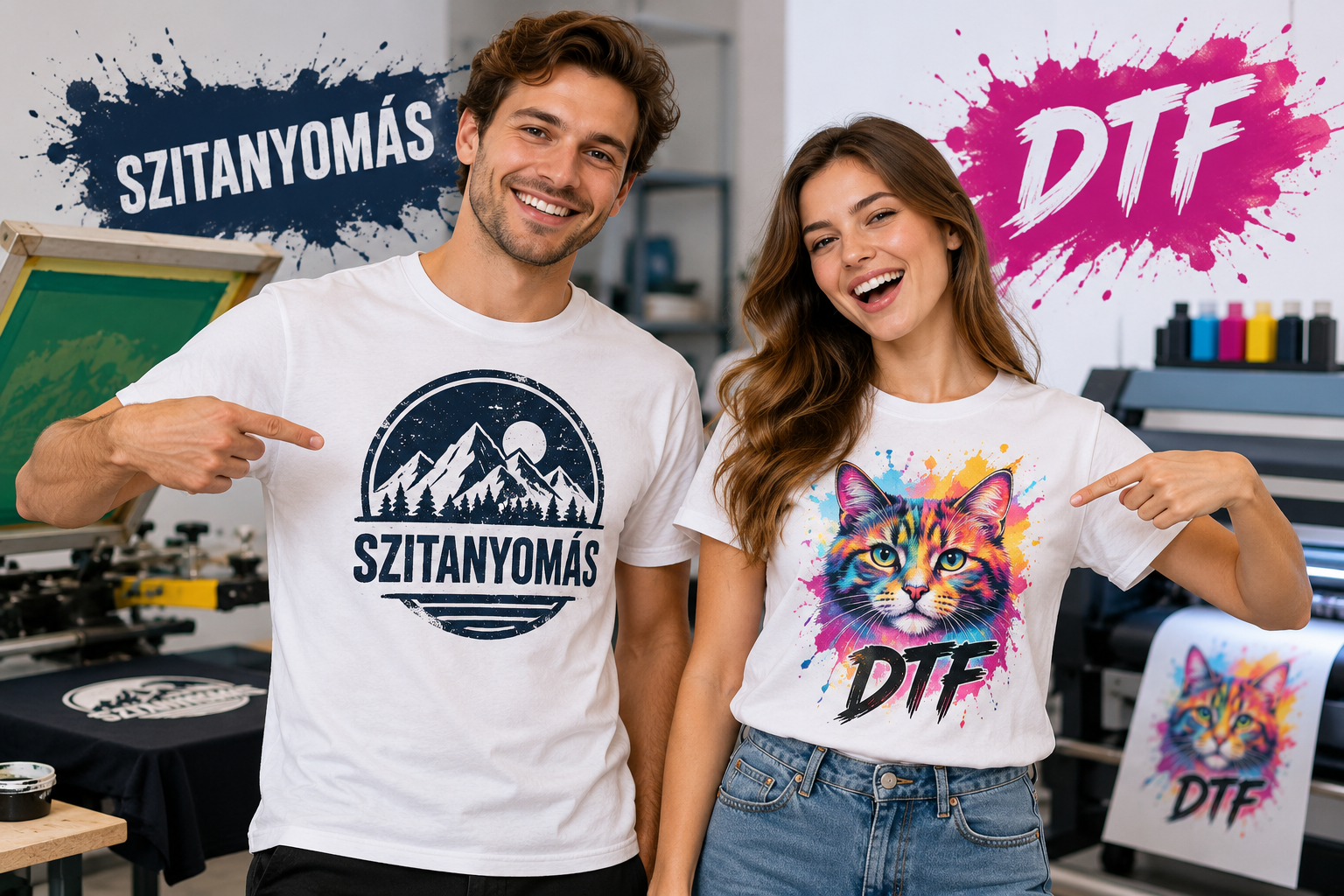
The two popular methods are DTF printing and screen printing. Both can produce excellent-quality products, but they are ideal for different jobs. We'll show you how they work, how they differ, and when you should choose which.
DTF printing – when the details matter
DTF (Direct to Film) is a modern textile printing method in which the graphic is first printed onto a special carrier film. The design is then fixed onto the surface of the fabric using a heat press.
The big advantage of the technology is that you don't need separate printing screens to create colorful, complex graphics. It can reproduce a multicolor illustration, a detailed emblem or even a photo-like design.
When should you choose DTF printing?
If your graphic has many colors, fine details or color gradients.
If you want to order a small or medium quantity of products.
If you want several different designs in the same order.
If you want your products made quickly and with relatively little preparation.
If you want to apply the graphic to fabrics of different colors.
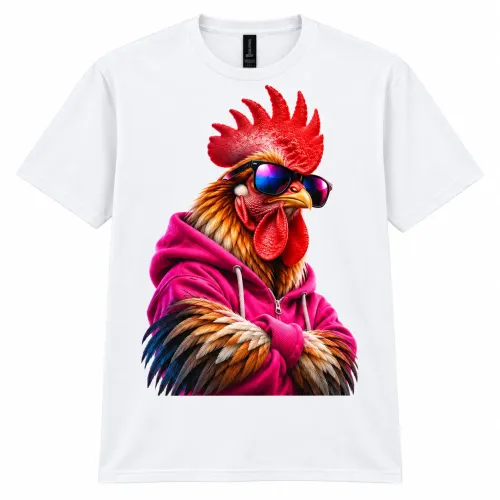
DTF is especially practical for custom T-shirts, smaller company clothing orders or promotional products where a rich, colorful look is important.
Screen printing – the proven technology for larger runs
Screen printing is a long-established, reliable textile printing method. The ink is pushed onto the fabric through a specially prepared screen. For multicolor graphics, a separate screen is usually made for each color.
This requires more preparation at first, but it can be a significant advantage for larger quantities. Once the screens are ready, the same graphic can be reproduced efficiently in large runs.
When is screen printing a good choice?
If you want lots of T-shirts, hoodies or bags with the same design.
If your graphic is simple, for example a one- or two-color company logo.
If a good unit price matters for larger quantities.
If you are ordering textile products for an event, a promotion or workwear.
If you want a uniform look for a larger team.
Screen printing shows its strengths most when the same design has to appear on many products. In that case, the preparation cost is spread across the whole order, so the price per piece can drop significantly.
How much does the order quantity matter?
One of the most important factors when choosing between the two methods is the number of pieces. However, there is no universal quantity threshold above which screen printing is always better and below which DTF always is.
The table below will help you find your way:
Quantity | Recommended technology |
|---|---|
1–20 pcs | Mostly DTF |
20–100 pcs | Often DTF; screen printing may also be an option for simple graphics |
100–300 pcs | The graphic and the number of colors are decisive |
300–1000 pcs | For simple, identical designs, often screen printing |
Over 1000 pcs | For large runs, typically screen printing |
The values are for guidance only. The most cost-effective solution can always be determined based on the specific order.
For example, for 500 T-shirts with a one-color company logo, screen printing will most likely be the better value. But if the same 500 T-shirts were to carry a multicolor, detailed illustration, it's worth comparing the costs of DTF too.
Which technology pays off for a one-color logo?
If your graphic consists of just one color, screen printing can be especially competitive.
For a one-color logo you only need to prepare a single screen, so the initial cost is relatively lower than for a multicolor graphic. With larger quantities, this cost is quickly spread across the products.
With smaller quantities, though, things are different. If you only need 15–20 T-shirts with a logo, making the screen can make the order disproportionately expensive. In that case, DTF is often the simpler and more economical choice.
So it's not just the number of colors, but also the quantity you order that determines which method works better for you.
Which print is more durable?
A common question is whether DTF or screen printing withstands regular use and washing better.
With the right materials and professional execution, both technologies can produce a durable print. The difference lies more in the structure and feel of the print.
With DTF, the graphic sits on the surface of the fabric as a thin, flexible layer. This allows tiny details and complex designs to be reproduced accurately, but on large, continuous printed areas the feel of the layer is more noticeable.
With screen printing, the ink goes directly onto the fabric. Depending on the ink and printing process used, prints with different textures can be made that are flexible and highly resistant.
Proper washing and care are also important for durability. It's best to wash printed clothing inside out, at the temperature recommended by the manufacturer, and to avoid ironing directly on the graphic.
T-shirt, hoodie or canvas bag? What we print on matters!
Your choice is also influenced by the material, surface and intended use of the textile product.
T-shirts: For custom, multicolor designs and smaller runs, DTF is often ideal. For larger quantities of company T-shirts with a simple logo, however, screen printing can be the better value.
Hoodies and workwear: Both methods can be used on various cotton and blended fabrics, but the composition and surface properties of the material must be taken into account. It's always worth choosing the right technology for the specific garment.
Canvas bags: For larger quantities of bags with a simple logo, screen printing is usually an economical solution. For smaller runs or complex, colorful graphics, DTF may be more practical.
DTF or screen printing? The key differences
Aspect | DTF printing | Screen printing |
|---|---|---|
Small quantity | Clearly advantageous | Preparation can be more costly |
Large quantity | Economical depending on the graphic | Often more cost-effective |
Multicolor graphic | Excellent choice | Requires more complex preparation |
One-color logo | Ideal for small runs | Ideal for large runs |
Photo-like graphic | Detailed reproduction | Requires special preparation |
Preparation time | Usually shorter | Requires more preparation |
Durability | Durable with proper execution | Durable with proper execution |
You don't need to know printing technologies – we'll help you choose!
For a company T-shirt, a clothing collection for an event or a promotional canvas bag, the same printing method doesn't necessarily give the best result.
At PrintONE, we help you find the right technology for your graphic, your chosen product and the quantity you order.
Relying on almost 25 years of experience in graphics and printing, as well as our professional partners, we look for a solution that meets your expectations in both quality and price.
Not sure which technology would work better for you?
Send us your graphic, tell us what product and how many pieces you'd like to order, and we'll help you choose the best solution!
PrintONE – We package your message.
Frequently asked questions
What is the difference between DTF printing and screen printing?
With DTF, the graphic is first printed onto a special film and then transferred to the fabric with a heat press. With screen printing, the ink goes directly onto the fabric using pre-made printing screens.
Which technology is cheaper for T-shirt printing?
For smaller quantities, DTF is usually more affordable, while for larger runs, especially with simple graphics, screen printing can be more economical. The exact price also depends on the number of pieces and the size and complexity of the graphic.
Can you print a photo on a T-shirt with DTF technology?
Yes. DTF is suitable for reproducing multicolor, detailed, even photo-like graphics. For a good result, you need a high-quality image with sufficient resolution.
Which printing technology withstands washing better?
Both methods can give a durable result with proper execution and care. The lifespan of the print is influenced by the ink, the fabric, the production technology and your washing habits alike.